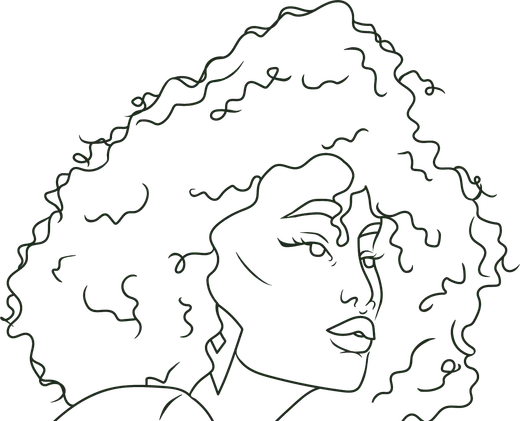
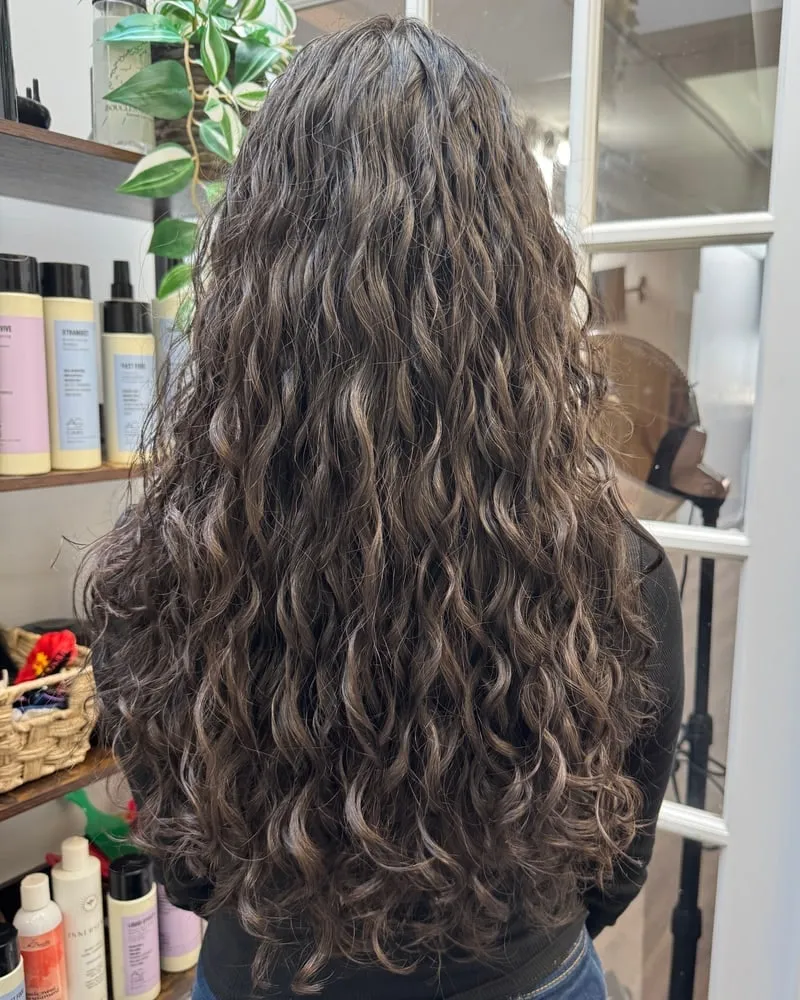
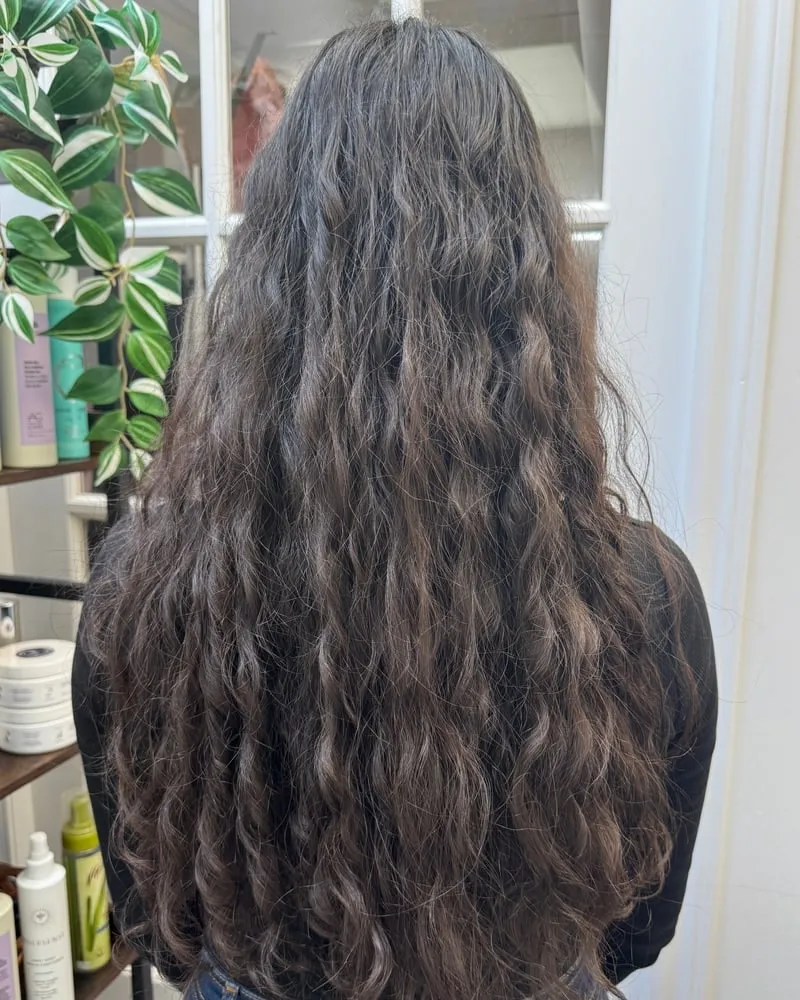
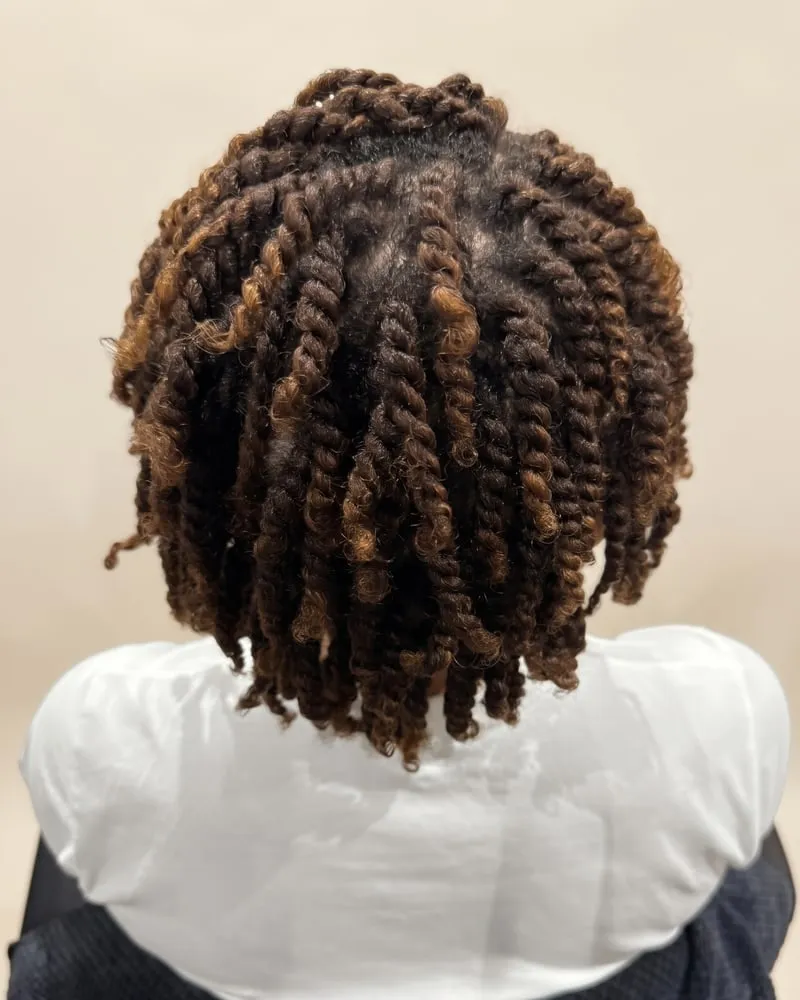
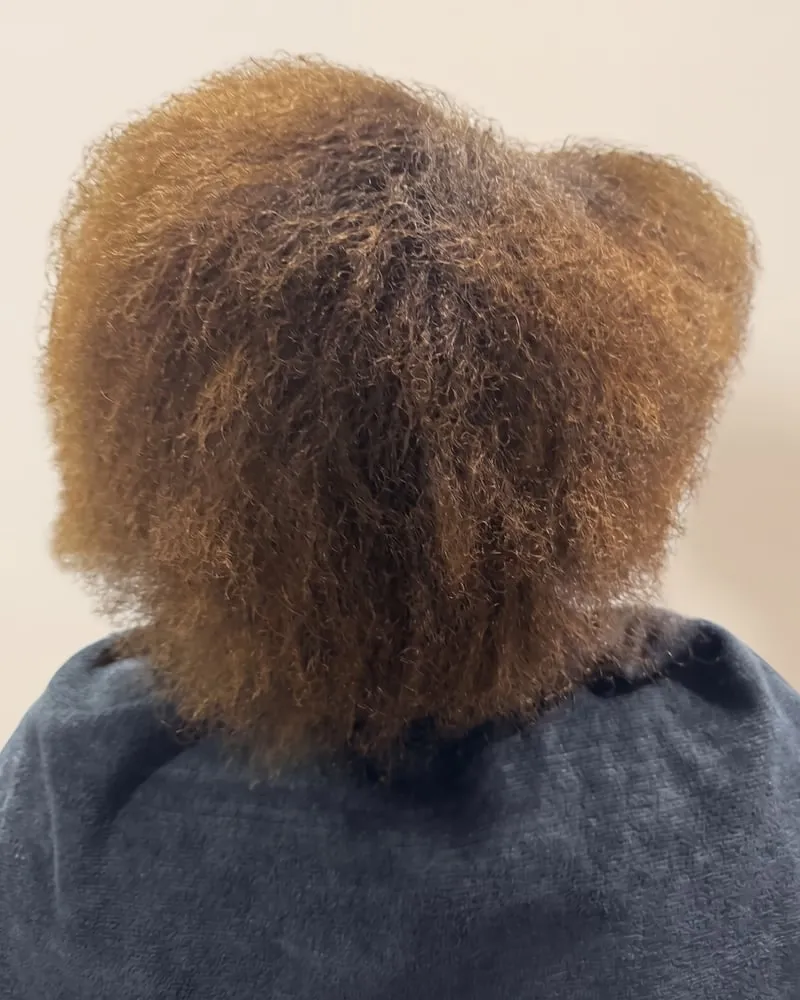
The hair type chart sorts hair into 4 families: 1 straight, 2 wavy, 3 curly and 4 coily. Each family is split into subtypes A, B and C, from the loosest to the tightest.
By Bianca Ponnusami, textured hair specialist · Published October 21, 2026
S-shaped waves, soft or more defined, that often lack volume at the root and frizz in humidity. The right cut and good definition bring out their movement without weighing them down.
Very tight coils or a zigzag pattern, with strong shrinkage as they dry. This hair type needs a gentle touch, moisture and a real understanding of its texture.
4BA Z-shaped zigzag with sharp angles.
4CA pattern so tight it looks blurry, dense and cottony.
Curly, tightly curled and coily hair is all she does. Trained in Mauritius and Paris, Bianca works with women, men and kids in Montreal who want healthy hair that’s understood and looks its best.
My hair has never looked as beautiful as it does with Bianca! I’ve been to several places, and this is by far my best experience. (…) She brought my curls back to life and gave me a gorgeous cut!
★★★★★
Mia B.Google review · Cut · translated from French
“
A true professional who takes her time. Not just to cut your hair but also to explain how it behaves and what it needs. You leave with a better understanding of your hair and a beautiful cut.
★★★★★
Nathalie C.Google review · Cut · translated from French
“
Bianca created exactly what I had in mind for my hair, and even went beyond my expectations! The highlights are stunning and the result shows off my curls perfectly, without changing their nature.
★★★★★
Lisa B.Google review · Balayage · translated from French
Book
Get to know your texture
An assessment with Bianca, so you know your curl type and leave with the right techniques.
Consultation30 min $35
Signature Coachingporosity, detox, moisture, guided definition2 hr 45 min $180
Signature Experienceassessment, treatment, cut, definition, PDF routine3 hr $215
Starting prices. Final price depends on length, density and curl type.
Look at a clean, product-free strand that has air-dried. Compare the shape of the curl to the chart: an S-shaped wave, a spiral or a small, tight coil. Check several areas, because most people have 2 or 3 types, often tighter at the nape and looser on top.
Wash your hair with a gentle shampoo, with no styling cream or gel.
Let it air-dry, without touching it or twisting it around your fingers.
Take three strands: at the front, on top and at the nape.
Compare the curl’s diameter to an everyday object: a piece of chalk (loose curl), a pencil (medium), a thin straw or a toothpick (very tight).
If you’re torn between two types, that’s completely normal. Go with your dominant type to choose your care, and adjust for each area.
What’s the difference between curly, tightly curled and coily hair?
It comes down to the size of the curl and how much it shrinks. Curly hair (3A, 3B) forms large, well-defined spirals. Tightly curled hair (3C, 4A) forms small, dense coils. Coily hair (4B, 4C) has very tight or zigzag curls and shrinks a lot as it dries.
Curly: 3A, 3B
Well-formed spirals, from the size of a piece of chalk (3A) to a marker (3B). Shrinkage stays moderate. These curls need lightness and definition. The common mistake: brushing them dry, which breaks up the curl and creates frizz. Recommended service: cut and curl definition.
Tightly curled: 3C, 4A
Small, tight curls the size of a pencil, very dense and full of volume. They shrink more and dry out quickly. Their main need: moisture, then definition. The common mistake: products that are too heavy and weigh the coil down. Recommended service: moisture treatment and definition.
Coily: 4B, 4C
Very tight Z-shaped curls (4B) or a pattern so tight it barely looks defined (4C). Shrinkage can be more than half the length. This is the most fragile hair: it needs a gentle touch, layered moisture and protective styles. The common mistake: detangling dry. Recommended services: deep conditioning, twists or coaching.
Is coily hair considered curly?
Yes. Coily hair is curly hair, sitting at the tightest end of the spectrum. The curl is very much there, even when you can’t see it with the naked eye because of shrinkage. Well moisturized and defined, 4B and 4C hair reveals its tiny coils.
4B or 4C: how can I tell the difference?
Look at the shape of the curl on clean, product-free hair. 4B hair forms a clear Z-shaped zigzag with sharp angles. 4C hair has a pattern so tight it looks blurry, and it shrinks even more. Many people have both, depending on the area.
A simple test: gently stretch a wet strand, then let it go. If it springs back into a visible Z shape, you’re more likely 4B. If it tightens into a small, dense mass with no clear pattern, you’re more likely 4C.
The difference matters mostly for your routine: 4C hair needs more moisture, even gentler detangling and styles that keep manipulation to a minimum.
What does 4C hair look like?
4C hair forms a very tight pattern, often with little visible definition, and looks dense and cottony. It can shrink by up to 70% of its length as it dries: hair that reaches your shoulders when stretched can look short. Well moisturized, it’s soft, supple and full of volume.
Shrinkage isn’t a flaw: it’s a sign of a healthy curl. It also explains why so many people with 4C hair feel their hair isn’t growing, when it’s actually growing normally.
Can hair type change with age, pregnancy or health?
Yes, texture can change over a lifetime. Hormones play a big role: puberty, pregnancy, postpartum, menopause. Repeated heat and relaxers can also loosen the curl. In children, texture often changes until the teen years, which is why their care should evolve over time.
Some medications, significant weight loss or a nutritional deficiency can also change how your curls look. If a sudden change comes with hair loss, talk to a health professional.
Is the hair type chart accurate?
It’s a useful shared vocabulary, but it isn’t enough on its own. Two people with 4C hair can have very different needs depending on their hair’s porosity, density and thickness. Those three factors matter as much as curl shape when building a good routine.
Porosity: your hair’s ability to absorb and hold on to water.
Density: how many hairs you have on your head.
Thickness: the diameter of each strand, fine, medium or coarse.
It all happens in the follicle, the tiny pocket the hair grows from. A round follicle produces straight hair. An oval, curved follicle produces hair that coils. Keratin is also spread unevenly along the strand, which accentuates the bend and creates the curl.
Which care and haircut suit each hair type?
The tighter the curl, the more moisture and gentle handling the hair needs. Loose curls mostly need lightness and definition. Coily hair needs deep conditioning, careful detangling and protective styles. The table below sums up what each family needs.
A 30-minute consultation ($35) lets you take stock of your texture and your needs. For a complete assessment with a treatment, cut, definition and a written routine to take home, the Signature Experience ($215, 3 hr) is designed for a first visit.
What’s the most common hair type?
There’s no reliable data on how curl types are distributed: no serious study has measured them on a large scale. What we see at the studio in Montreal is a wide variety, and above all that almost every head mixes several curl types at once.
Is my hair 4B or 4C?
4B hair forms a clear Z-shaped zigzag. 4C hair has a pattern so tight it looks blurry, and it shrinks more. Many people have both.
Can my hair type change?
Yes. Hormones (puberty, pregnancy, menopause), repeated heat and relaxers can change your curl. In children, texture often evolves until the teen years.






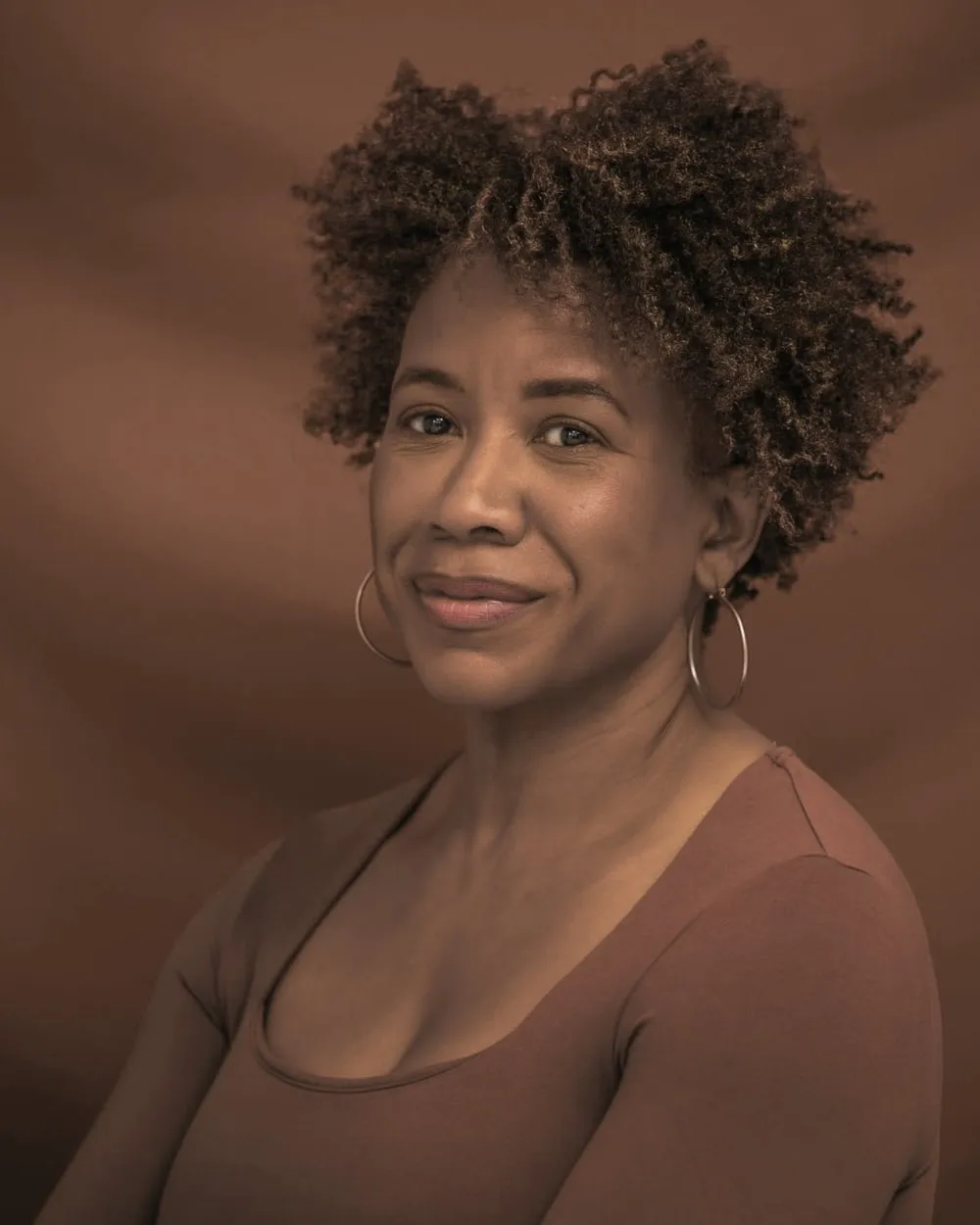

 Mia B.Google review · Cut · translated from French
 Nathalie C.Google review · Cut · translated from French
 Lisa B.Google review · Balayage · translated from French